Why the Natural History Museum of Utah remounted its dinosaurs
The museum opened in a former university library in 1969 and moved to the Rio Tinto Center in 2011, where its skeletons were put back together correctly.

When the Natural History Museum of Utah moved in 2011, its skeletal mounts got a correction. In the old building, the skeletal mounts stood in the wrong posture. At the new building they were remounted in anatomically correct postures.
The old building was the George Thomas Library, at 1390 Presidents Circle on the University of Utah campus. A library reading room there became museum space when the Utah Museum of Natural History opened to the public in 1969. The idea dates to 1959, when a university faculty committee decided to consolidate natural history collections from around campus. The Utah State Legislature established the museum in 1963. It opened with specimens from the Deseret Museum and from the Charles Nettleton Strevell Museum, which had been in the old Lafayette School on South Temple Street from 1939 until 1947.
Dinosaur bones dug from the Cleveland-Lloyd Dinosaur Quarry are part of the museum's collections. In 1960, James Henry Madsen Jr. was hired as an assistant to Professor William Lee Stokes of Princeton, who was digging there, and the two founded the University of Utah Cooperative Dinosaur Project. It ran for 16 years, from 1960 to 1976, with museums and research centers in the United States and abroad. Tons of fossilized bones came out of the quarry, including Camarasaurus, Camptosaurus, Ceratosaurus, Stegosaurus and Allosaurus. Allosaurus is the best represented, with 44 to 46 individuals found. Two new species were named from the dig, Stokesosaurus in 1974 and Marshosaurus in 1976, and the holotypes of both are preserved at the museum.
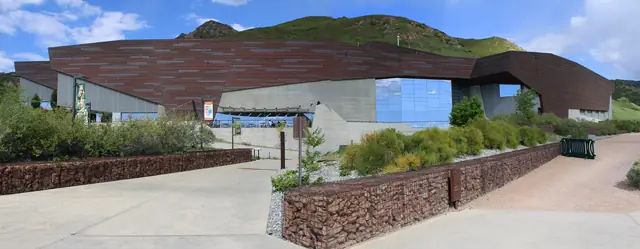
The museum's current home, the Rio Tinto Center, opened in November 2011 and brought the name Natural History Museum of Utah with it. The building covers 163,000 square feet on a 17-acre campus in the foothills of the Wasatch Mountains, in the university's Research Park. Ennead Architects of New York City and GSBS of Salt Lake City designed it, and Ralph Appelbaum Associates designed the exhibits. The highest point of the building is a round structure on the east side, which houses the Native Voices gallery.
The approach is uphill. Two levels of surface parking sit next to the building, and footpaths, stairways and ramps lead up to the main entrance. Markers along the footpaths indicate major geological time periods covering 150 million years, so some of the deep time happens before you reach the door.
Inside, twelve permanent exhibitions fill four levels. They include Great Salt Lake, Gems & Minerals, First Peoples, Native Voices and Past Worlds. The collections hold nearly 2 million objects, and the mycology collection, started in 2016, is still growing. The rest of the list is Life, Land, Our Backyard, News From Our Scientists, Utah Futures, Poetry Path and Climate of Hope.
Sources
Written from the pages above. Spotted something wrong? Tell us.