From Artillery Range to Living History Village
The land under This Is The Place Heritage Park was once a firing range for Fort Douglas, and the changes since then run to a rebuilt store and a relocated cabin.

Before it had a train, a pony carousel or a single costumed interpreter, the land at This Is The Place Heritage Park was an artillery firing range for nearby Fort Douglas. It is now a state park of more than 450 acres on the east side of Salt Lake City, at the foot of the Wasatch Range near the mouth of Emigration Canyon. These days the Candy Cannon caps the day at the fall event Little Haunts with a boom and a scramble to gather taffy in the streets. That is a smaller caliber of event.
The spot was already significant. It is the place where, on July 24, 1847, Brigham Young first saw the Salt Lake Valley. The words "this is the place" were first attributed to him by Wilford Woodruff more than thirty years after the pioneers arrived. Markers came later. In 1917, B. H. Roberts and a Boy Scout troop built a wooden one. In 1921 it was replaced by a white stone obelisk, which still stands.
The big monument took longer. In 1937 the State of Utah commissioned the sculptor Mahonri M. Young, a grandson of Brigham Young, to design and create it. The This Is The Place Monument was dedicated in 1947, on the 100th anniversary of the pioneers' entry into the valley, at a ceremony attended by nearly 50,000 people. In 1957, a group of private citizens bought much of the land now in the park and gave it to the State of Utah to preserve it from commercial development.
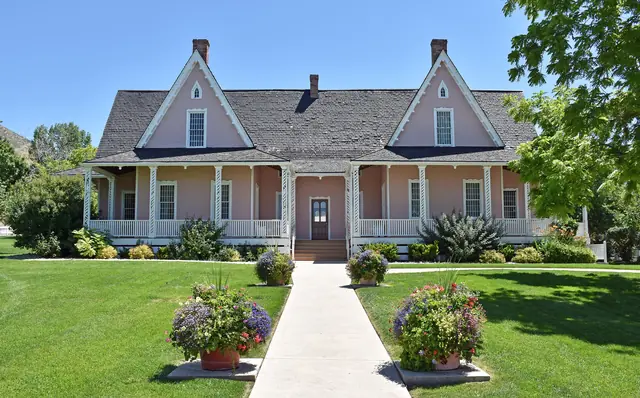
The village came next, and it was built in stages. Around 1959 a small visitors' center went up near the monument, with a large mural by the local artist Lynn Fausett. Restoration and replication of historical buildings began in 1975, the same year Young's Forest Farmhouse was moved to the park from the Forest Dale area. In 1979, five original pioneer homes were donated and restored. The 1980s added a replica of the original Social Hall from downtown Salt Lake City, a blacksmith shop, and several relocated homes and a log cabin.
From 1992 through 1995 the park went through a period of major expansion. The Manti Z.C.M.I. store was dismantled and reconstructed in the park, a pioneer dugout home was built, and 15 replica structures went up. The Hickman Cabin was relocated from Fairfield. Later additions include a replica of the Brigham Young Academy, a Pioneer Playground and Petting Corral, and a splash pad called Irrigation Station, which is there to teach about water use in Utah.
Visitors walk through settler homes and shops, talk with costumed interpreters, and try hands-on activities such as rope making and candle dipping. Between buildings there is a replica train, a pony carousel and a yard of farm animals, including goats, sheep, pigs and chickens.
The monument grounds are worth a separate loop. Mahonri Young's monument anchors the park, and the 1921 white stone obelisk still stands east of the 1917 monument.
Sources
Written from the pages above. Spotted something wrong? Tell us.